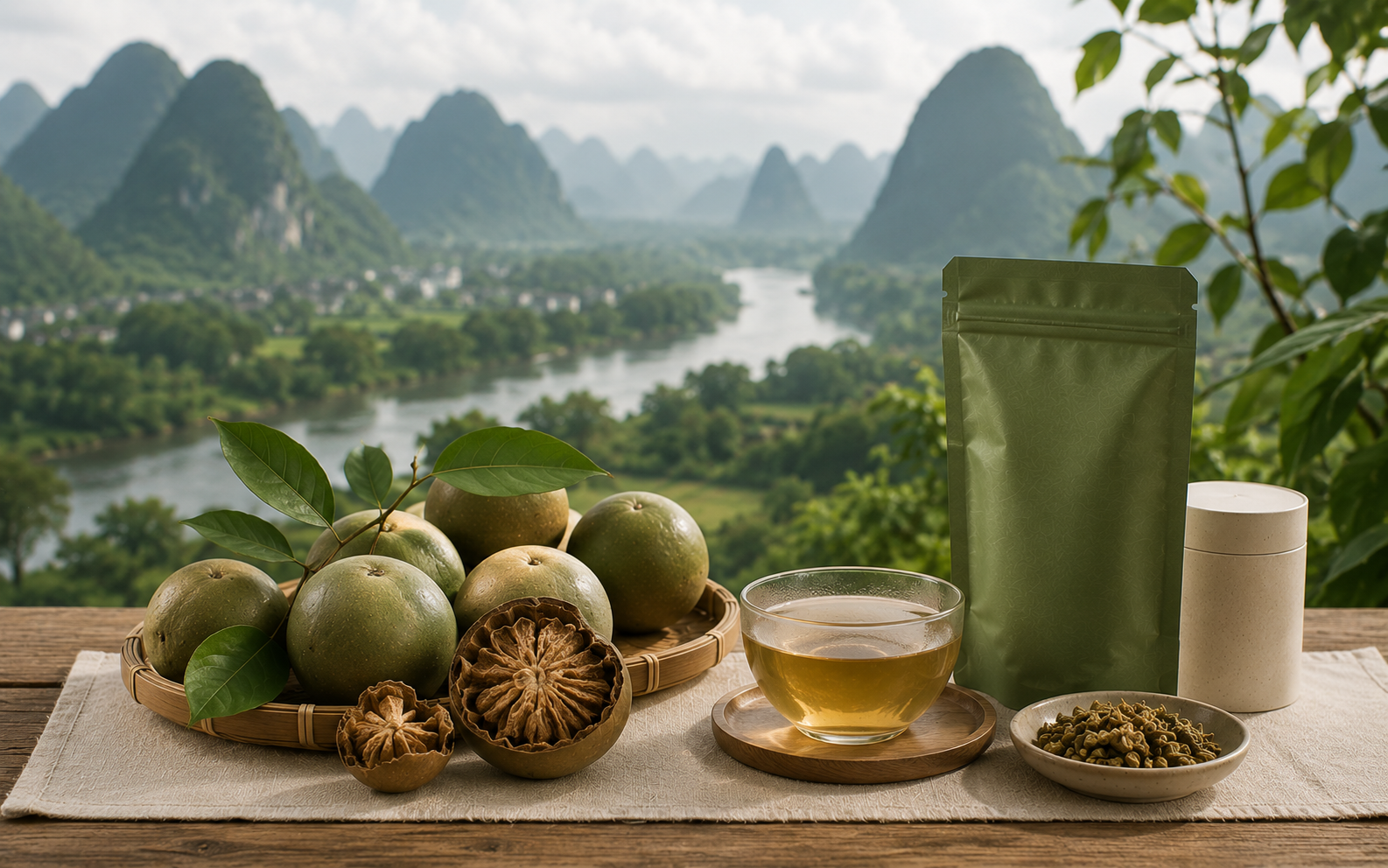
For international buyers sourcing monk fruit products, understanding the origin story provides important context for quality evaluation and supply planning. Monk fruit (luo han guo) grows almost exclusively in the Guilin region of southern China, where unique climatic conditions and traditional cultivation knowledge create the foundation for this natural sweetener. This article explains what buyers should know about monk fruit origins, harvest cycles, and supply considerations.
The Guilin Growing Region
Monk fruit cultivation is concentrated in the mountainous areas surrounding Guilin in Guangxi Province, China. This region provides the specific conditions the plant requires: subtropical climate with abundant rainfall, misty mountain environments with diffused sunlight, limestone-rich soil, and elevation between 300-500 meters.
Attempts to cultivate monk fruit in other regions have generally produced inferior results, making Guilin the essential origin for quality monk fruit products. This geographic concentration has implications for supply—essentially all commercial monk fruit traces back to this relatively small growing region.
For buyers, this means origin verification is straightforward. Legitimate monk fruit products should trace to Guilin area suppliers with established growing relationships.
Cultivation and Harvest
Monk fruit is a perennial vine in the cucumber family. The fruit develops from small yellow flowers into round green fruits about 5-7cm in diameter. Harvest timing significantly affects quality.
**Growing Season** – Vines are planted or regrown in spring. Flowering occurs in summer. Fruit develops through late summer into fall.
**Harvest Window** – Primary harvest occurs August through October. Fruit must be picked at optimal ripeness—too early and mogroside content is low; too late and fruit quality degrades.
**Post-Harvest Processing** – Fresh monk fruit is highly perishable. It must be dried within days of harvest to preserve quality. Traditional slow-drying methods are preferred for premium products.
This concentrated harvest window means that annual production is essentially fixed each year. Supply-demand dynamics shift based on harvest quality and yield.
Understanding Mogroside Content
Mogrosides are the natural compounds that provide monk fruit's sweetness. Understanding mogroside specifications helps buyers select appropriate products:
**Mogroside V** – The primary sweet compound. Higher mogroside V content generally indicates higher quality and sweetness intensity.
**Extract Concentrations** – Monk fruit extracts are available in various concentrations, typically ranging from 25% to 55% mogroside V content.
**Application Matching** – Higher concentration extracts work for beverages and food formulation where intense sweetness is needed. Lower concentrations or dried fruit pieces work for tea applications where subtle sweetness is preferred.
When evaluating suppliers, ask for mogroside content specifications and third-party testing documentation. Legitimate suppliers will have this information readily available.
Supply Chain Considerations
The concentrated geographic origin of monk fruit creates supply chain considerations buyers should understand:
**Seasonal Availability** – Fresh-processed monk fruit becomes available after the fall harvest. There may be premium pricing for early-season product.
**Quality Variation** – Like any agricultural product, quality varies by growing conditions each year. Establish relationships with suppliers who maintain consistent quality standards.
**Price Fluctuations** – Harvest yield affects pricing. Poor harvest years see price increases; strong harvests may bring pricing relief.
**Inventory Planning** – Given the single annual harvest, buyers with consistent volume needs should plan inventory to bridge between harvest seasons.
Working with established suppliers who maintain year-round inventory and quality control helps mitigate supply variability.
Quality Indicators
When evaluating monk fruit products and suppliers, look for these quality indicators:
**Origin Documentation** – Can the supplier trace products to specific growing areas? Legitimate suppliers maintain origin documentation.
**Processing Methods** – Traditional slow-drying methods generally produce better quality than rapid industrial drying.
**Testing and Certification** – Third-party testing for mogroside content, heavy metals, pesticide residues, and microbiological safety.
**Sensory Evaluation** – Quality monk fruit products should have clean sweetness without off-flavors or bitterness.
**Consistency** – Can the supplier deliver consistent quality across orders? Request samples from different production batches to evaluate.
Building relationships with suppliers who prioritize quality at each stage from cultivation through processing ensures reliable product for your applications.
Working with Origin-Connected Suppliers
The most reliable monk fruit sourcing relationships involve suppliers with direct connections to the Guilin growing region. These suppliers can:
- Verify origin and traceability - Maintain quality control from harvest through processing - Provide consistent product specifications - Communicate seasonal availability and pricing trends - Support documentation requirements for your market
When evaluating suppliers, ask about their relationship with growers and processors. Direct relationships typically indicate stronger quality control and supply reliability than trading companies sourcing opportunistically.